Reflections from the team at Kinetic, for Mental Health Awareness Week 2026
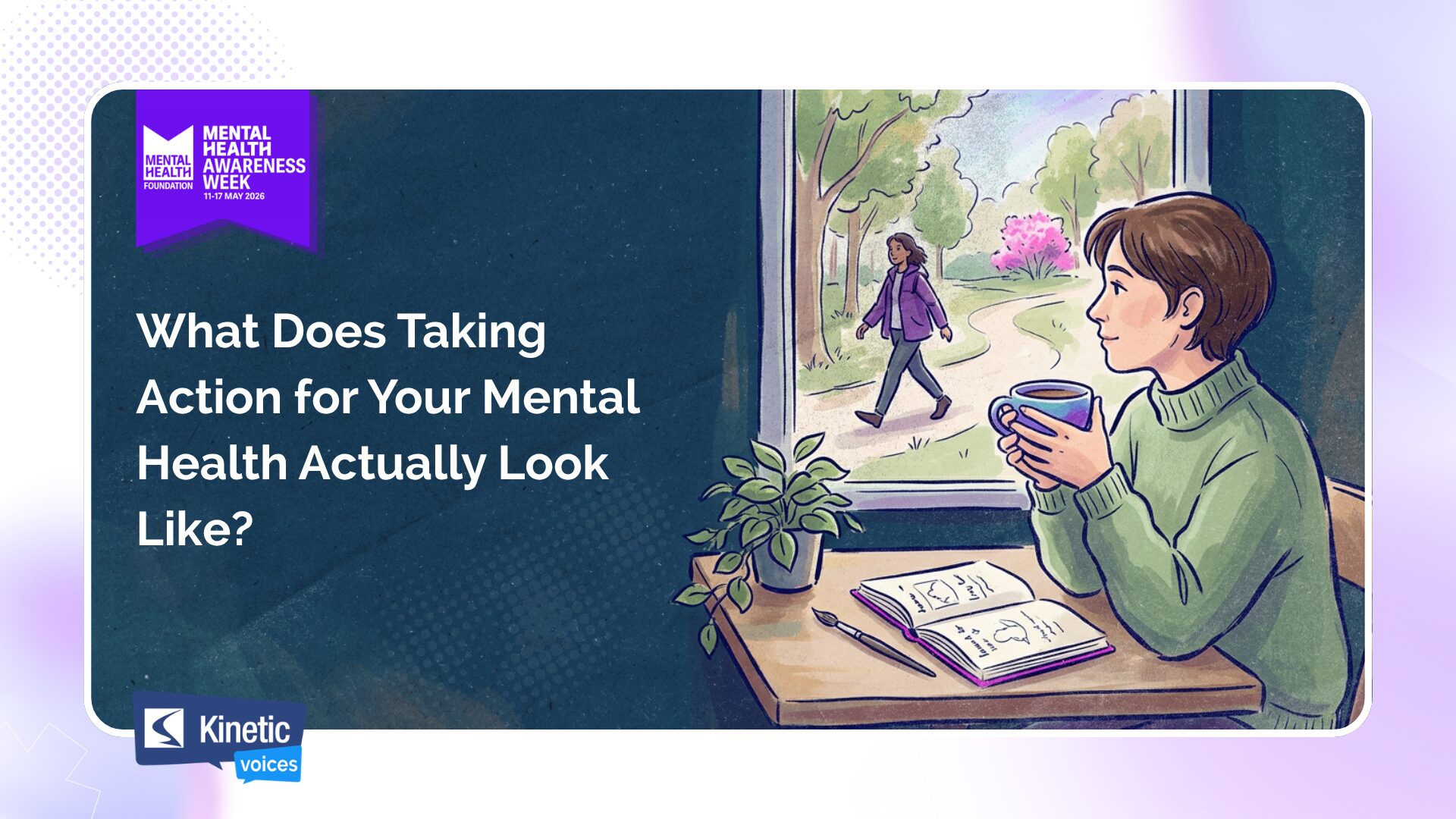
This year’s theme for Mental Health Awareness Week is Action – for yourself, for someone else, for all of us.
It’s a theme that resonates. Because we’ve all become pretty good at talking about mental health. What’s harder is the bit that comes after the conversation.
So we asked our team a simple question: What does taking action for your mental health actually look like for you?
Here’s what they said.
It starts with permission
Before anything else, the responses pointed to something that doesn’t get said enough: you have to let yourself.
Rob Johnstone, our Head of Commercial Product, put it best. He juggles two demanding roles – leading product at Kinetic and being a dad to two children under ten. The mental load of holding both, he says, “can quietly build up without you noticing.” His action? Journalling. A few minutes each day: how am I feeling, what went well, what’s blocking me.
“The most valuable part? Giving yourself permission to acknowledge a bad day for what it is. Note it, close the book, come back tomorrow refreshed and ready to go.”
That’s the foundation everything else rests on. Not fixing the bad day. Not reframing it. Just naming it, and moving on.
The actions that work are the ones that are yours
Once you have that permission, the next thing our team’s responses make clear is this: there is no universal answer.
Barry Anns, our CEO, kept it to one sentence. “Going for a walk is my go-to.” Simple. Repeatable. No app required.
Nilam Kotadia-Vaidya, PMP, CSM, CSPO, Implementation Specialist, treats movement like a meeting. “It’s not always at the same time every day – sometimes it’s early morning, sometimes during lunch, sometimes squeezed between meetings. The key for me is actually putting it on my calendar and treating it like any other commitment. That’s what helps me follow through.”
And then there’s John Mosley, Systems & Configuration Analyst, whose list includes going wild at soft play with his daughter, live music of any genre, a long bath, time at a farm or zoo, and – our personal favourite – eating extremely hot hot sauce to kick his senses back into action.
There’s something quietly radical about a list like that. It doesn’t look like what mental health action is supposed to look like. And that’s exactly the point. The actions that work are the ones that fit your life, not someone else’s prescription.
Small, deliberate, and fully present
Several people described a quality their actions share, even when the actions themselves look nothing alike: presence.
Zoe Carballo, Customer Care Analyst, gets out into nature – exploring with a camera or spending five quiet minutes in her vegetable garden. “Whatever I do, I try to be fully present in the moment. It helps me clear my mind. Then I can return to what I was doing before with a fresh outlook.”
David Landau, Senior QA Analyst, has his Saturday ritual: his local coffee shop, a book, a mocha, and a cinnamon bun. An hour of letting his brain switch off and go somewhere else entirely. On days he can’t get out, he paints watercolours. “Doesn’t matter what I’m painting. The actual act of painting, I find really therapeutic.”
The activity, in both cases, is almost beside the point. What matters is the quality of attention given to it.
Creativity, purpose, and the people around you
For others, action means reaching for something creative – not as a hobby, but as a genuine reset.
Clare Ody, FIoL, PC.dp.(GDPR), Our VP of PBSA, Brand, and Partnerships, moves between the garden, the beach, painting, printing, and DIY. “These give me another way to keep my brain active but calming it at the same time.” She also spoke about her work as a trustee of a charity. The fundraising, the events, the people. “Finding purpose in something very personal and emotionally painful can transform my mental wellbeing into a positive state of mind – and help others with their mental health at the same time.”
Action for yourself and action for others, in the same breath. That’s the theme of this week made real.
Heba Khan, Marketing Coordinator, has her own list: doodling, paint by numbers, cooking, the gym, writing poetry, and dancing around to music. And phone calls with friends that start as “a quick five minutes to feel lighter” and almost always run to an hour or more.
What this tells us
We work with the higher education sector every day. We see the pressure those institutions are under and the people within them. With students navigating some of the hardest years of their lives and staff managing more than they’re often given credit for.
Mental health doesn’t sit separately from the work. It’s woven through it.
What our team reminded us, in eight very different answers to the same question, is that action doesn’t have to be big to matter. It has to be real. A walk. A journal. A bath. A phone call that overruns. A cinnamon bun and an hour away from a screen. These aren’t indulgences. They’re maintenance.
The theme this year is right. Awareness got us here. But action is what moves things forward – for yourself, for the people around you, and for all of us.
So, what’s the one thing you’ll actually do for yourself?
Read more Kinetic Voices here.