By Rob Johnstone, Head of Product at Kinetic and Pip Kelly, Business & Solutions Executive, Kinetic
Over the past year, we ran workshops, conducted focus groups, carried out surveys and visited catering teams on-site. We embedded ourselves in their world to understand what they needed to run smooth operations, meet expectations, and deliver for their customers using the right university catering software.
What became clear was that the ambition was there and the right teams were in place, but the technology wasn’t always keeping pace. For some, that meant working around the limitations of older systems that had served them well but were no longer fit for the direction their operations needed to take. For others, it meant relying on disconnected tools, each doing one job reasonably well but creating complexity the moment you needed a complete picture. In almost every conversation, gaps emerged between what the technology offered and what the operation demanded.
What teams told us
University catering operations are typically running several disconnected tools at once. They will have an events platform for conference and room bookings and a separate system, or no system at all, for delivered catering. Printed run sheets move between the kitchen and front-of-house teams, and manual exports are dropped into spreadsheets to pull the data together. And somewhere in the middle of all of that, a team is trying to serve hundreds, sometimes thousands, of customers every day across very different types of orders.
One manager described manually exporting booking data from one system, re-entering it into another, and then compiling a weekly spreadsheet for finance. Every single week. For years! Another told us they were spending a significant portion of their working week manually managing booking restrictions to prevent the kitchen from being overcommitted, a task that, in their words, “should just happen automatically.” A third described the process of coordinating catering for an external conference as “an email chain that never really ends.
A catering director reflecting on their student customers:
“We needed a system that gives us complete control over our catering operations whilst providing the modern experience our students expect.”
Control on one side, experience on the other hand and too often, the tools force a choice between the two.
What we know about the sector
University catering is not a small or simple operation. According to CUBO College and University Business Officers 2025 data, the sector generates £1.6 billion in catering and hospitality revenue annually, averaging £4.77 million per institution, which is serious commercial territory, and the operational inefficiencies sitting behind it have a real cost.
The sustainability pressure also exists. Research commissioned by TUCO Ltd (The University Caterers Organisation) found that the UK education sector generates 123,000 tonnes of food waste every year, costing £250 million. Better pre-ordering, smarter demand forecasting, and accurate stock management all meaningfully reduce waste. But those things require data, and data requires systems that are actually joined up.
And then there is the compliance picture. Managing allergen information and dietary requirements at scale is one of the most operationally demanding aspects of running a university catering operation. Among UK undergraduate students, 10% are vegetarian, 7% are pescatarian, and 5% are vegan, according to the Food Standards Agency. That is before you factor in the full range of allergen needs across a diverse student population. When that information lives in multiple places or is updated in one system but not another, it becomes an operational and safety risk. Then there is the nuance of preferred food options to serve a diverse customer base.
What we know about customers
The teams we spoke to serve several customers, all at once, all with different expectations. Students are the most visible. 69% of Gen Z consumers use food delivery apps regularly, ordering via delivery an average of 4.5 times per month, outpacing every other age group. This generation has grown up with seamless digital ordering as the standard experience, not a bonus. Filtering by dietary preference, seeing allergen information clearly, saving favourites, and paying instantly from a phone. These are baseline expectations for this cohort.
And as one catering director told us: “Our students want a Deliveroo-type approach to ordering campus catering. We had to meet those expectations or lose revenue to external providers.”
Internal staff are a different customer entirely. A department coordinator booking meals for a Friday afternoon meeting wants clarity and speed. They want to confirm an order without a phone call and a follow-up email. They want to know the catering will arrive at the right time, to the right room, without chasing anyone.
External clients bring a third set of needs. Organisations booking rooms and conference facilities on campus are often high-value customers. When they add catering to a booking, they want the same confidence and flexibility they would expect from any professional hospitality provider. When the process feels disjointed or unreliable, some simply do not bother. That revenue doesn’t show up anywhere as a loss; it just never arrives.
What this means for university catering software
Here is what we took from all of it. University catering teams are short of tools that match the complexity of what they do. The operational friction they carry every day – the system switching, the manual workarounds, the printed sheets, the spreadsheets, the email chains – is an inconvenience for the team and flows downstream. It affects how quickly allergen information gets updated. It affects whether a student can order from their phone or gives up and opens Deliveroo. It affects whether an external client books catering or skips it. It affects whether a manager has the reporting they need to make smart decisions about menus, capacity, and revenue. The disconnection between systems is a business problem.
What good university catering software looks like
The institutions making the most progress are not necessarily those with the biggest budgets. They are the ones that have moved to a single, unified platform that covers the full range of catering activity, from daily student orders to delivered departmental catering to conference and event management, with one consistent experience for customers and one clear operational picture for the team.
In practice, that means:
- Automated booking restrictions that protect kitchen capacity without manual intervention.
- Real-time menu and allergen updates are pushed across every customer touchpoint simultaneously, so information is always accurate and always consistent.
- A branded, mobile-first ordering experience that students, staff, and external clients can actually use without friction.
- Group ordering functionality that lets a department coordinator pull together a team lunch without a single email.
- Integrated card payment processing is available around the clock.
- And reporting that tells you what is actually happening across the operation, not just what one system can see.
When pre-ordering is easy and accessible, waste is reduced. When allergen information is centralised, the risk of error drops. When the on-campus experience is as good as what students get elsewhere, the revenue stays where it belongs.
As one manager put it after making the shift: “Keeping catering revenue in-house rather than losing it to external platforms was crucial for our commercial strategy.”
University catering is a complex operation. The food, the people, the compliance, the sustainability commitments, the diverse customer base, and the commercial expectations all have to work together every single day. After a year of listening, it’s clear that for an operation this complex, the right tools make all the difference.
If you manage catering at a university or college, here is something worth sitting with.
Think about your operation as each of your customers would experience it today. A student is between lectures, trying to order lunch on their phone. A department PA is booking catering for a meeting happening next week. An external delegate is arriving for a full-day conference, whose organiser added catering to the booking three weeks ago. At each of those touchpoints, what does the experience actually feel like? Where does the friction sit? And what is that friction costing, in time, in revenue, and in the confidence of the people relying on you? These questions shaped our catering management platform, built with university catering teams, for catering teams.
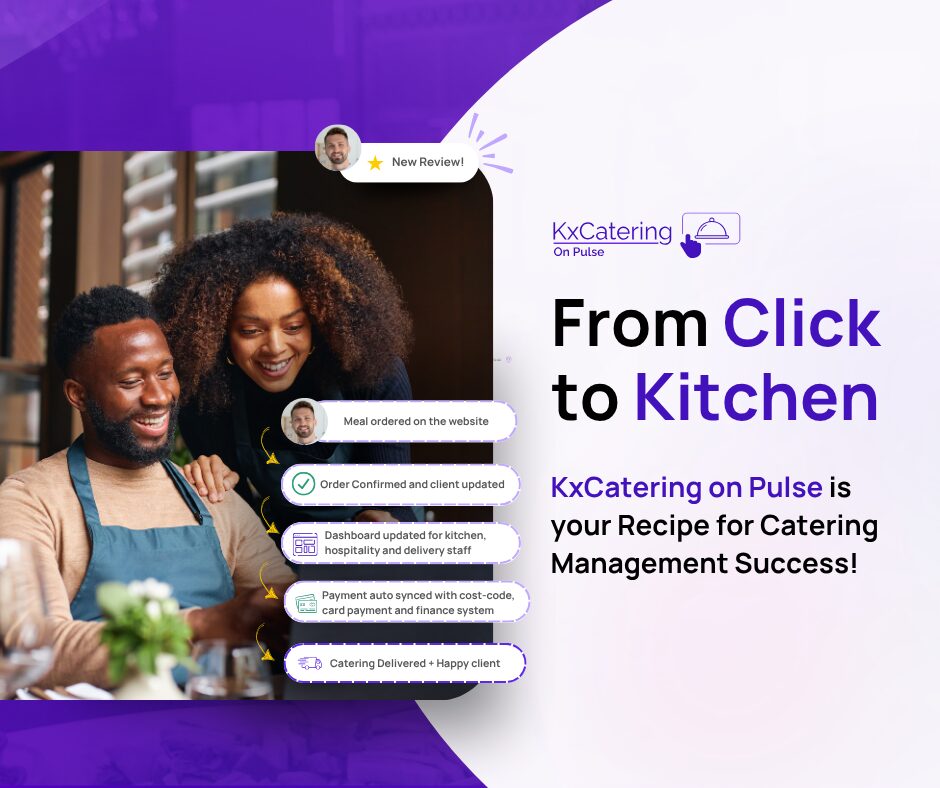
Explore our KxCatering solution: https://kineticsoftware.com/kxcatering-management-solution/
Read more Kinetic Voices here.