By Bella O., Kinetic Software with Fiona Cooper and Quinten Gazendam, Smarthotel.
When searching for accommodation, conference venues, or meeting spaces, most people do not think to consider universities. Instead, they typically compare options through hotel booking sites, venue-finding platforms, search engines, and increasingly, AI-powered discovery tools. This means that university accommodations can only enter the decision-making process if they appear on the platforms users are already utilising.
For universities, this raises a commercial question that goes beyond simple occupancy rates. Even if your institution has quality rooms, excellent facilities, competitive pricing, and additional amenities such as meeting rooms and catering services, these assets can only generate revenue if potential guests discover them during their booking journeys.
At Kinetic Live 2026, during a session delivered by Fiona Cooper and Quinten Gazendam from Smarthotel, attendees learnt that universities generated £45 million through online travel agents in a single year using BedBooker, Kinetic’s channel management platform. From the £45 million, one university alone generated £16 million through online travel agents, illustrating what is commercially possible for other universities.
Your market is bigger than campus demand
Data from BedBooker also revealed that over 159,000 bookings were made through online travel agents for universities in a single year, representing travellers who searched for accommodation and ultimately chose to stay in university accommodation. While universities typically have data on their own bookings, they often lack insight into individuals who searched in the same area but did not encounter university accommodations during their decision-making process.
This shift in perspective changes how we think about performance. Occupancy data reveals how many rooms were sold, but it does not indicate the total demand in the market or what proportion of that demand reached your institution.
Take Keble College as an example: Oxford attracts around seven million visitors each year, and the college has 334 bedrooms in a city where hotel availability is often limited. Instead of relying solely on guests to find them directly, Keble College used BedBooker to list their available rooms across more than 100 online travel agents, including Booking.com and Expedia.
Their goal was to achieve 100% occupancy, which represented an increase of around 25%. By using BedBooker, they accomplished this goal, successfully competing for bookings from travellers already visiting the city.
Many universities are similarly positioned in areas with strong demand for accommodations due to conferences, tourism, business travel, and local events. Analysing how much of that demand reaches your institution offers a broader perspective on commercial performance beyond just occupancy.
Tapping into available demand is only the beginning for universities
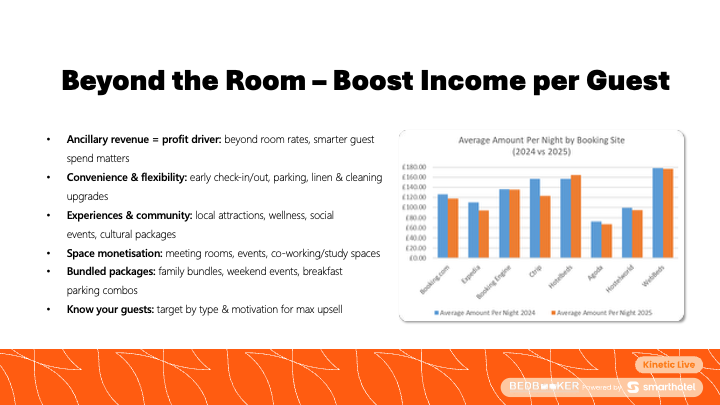
Getting more bookings is important, but there is another opportunity that often gets overlooked. At Kinetic Live 2026, Fiona and Quinten highlighted something the hotel industry has understood for years: the value of a guest extends beyond the room they book.
The first opportunity is during the stay itself, when a guest arriving on campus may need parking, catering, meeting space, coworking facilities, gym access or other services available through the university. The room booking opens the door to a wider range of services that can increase the value of each stay while creating a better experience for the guest. The figure above shows nightly rates have dropped, but volume is higher. Average daily rates (ADR = Total Room Revenue ÷ Number of Rooms Sold) are actually up by £10 per night. Guests are looking to pay more for premium rooms and add-ons to enhance their stay.
The second opportunity begins after they leave: a positive stay can lead to a repeat booking, a conference enquiry, an event booking, or a direct relationship that removes the need to go through a third-party booking platform next time, saving on the commission fee these platforms take. Someone visiting campus today could return next year with colleagues, organise an event or become a regular guest.
The opportunity is already there. CUBO’s 2025 Commercial Services Benchmarking Report found conferencing revenue increased by 9% during 2023/24, highlighting continued demand for conferences and events across the sector.
Adapting to changing consumer search habits for universities
The way guests find accommodation has changed significantly in recent years. Someone planning a stay may start with Google, compare options on an online travel agent website like Booking.com, explore destination websites, read reviews and increasingly ask an AI assistant for recommendations before deciding where to book.
Accommodation is now discovered through many different channels, and if your rooms are only visible in one place, you’re relying on guests already knowing who you are. Most travellers start by looking for accommodation in a destination and then compare the options available to them. This makes visibility more important than ever. Rates, descriptions, images and reviews all play a part in whether your accommodation appears in front of a potential guest and whether it makes their shortlist.
AI is becoming part of this journey too. AI assistants draw on the same listing data, reviews and distribution channels that already power online travel agencies and search platforms. As more guests use these tools to plan and book their stay, accommodation that is widely available across booking channels has more opportunities to be discovered throughout the decision-making process.
Catching demand is one thing. Managing it is another
Reaching more guests is only part of the picture. Once your accommodation is listed across multiple booking platforms, room availability needs to stay accurate everywhere guests can book.
Staff often need to update room stock, rates and property information across multiple channels. Every pricing change, room closure or availability update has to be reflected wherever guests might make a booking.
As the number of channels grows, so does the chance of something being missed. A room sold through one platform can remain available somewhere else, creating the risk of a double booking. The result can be disappointed guests, lost revenue and additional work for staff to resolve the issue.
Hotels have been managing this challenge for years through channel management technology that keeps room availability synchronised across booking platforms in real time. Universities now have access to the same approach through solutions built specifically for higher education accommodation.
At Keble College, room availability is synchronised automatically between BedBooker and its residential management system, removing the need to maintain listings across multiple platforms by hand. Every booking and availability update is reflected across connected channels, giving staff confidence that they are always working with accurate, up-to-date information.
As Reservations and Accommodation Manager Sinèad Webster explained: “It’s not only saving time; it’s working more productively.”
Calculate your potential revenue from OTAs
Universities generated £45 million through online travel agents in a single year using BedBooker. The question is, how much of the demand in your area is currently reaching your accommodation?
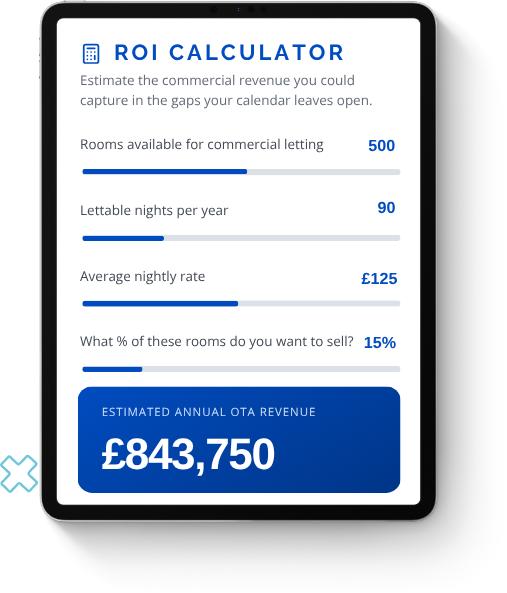
Travellers are already searching for places to stay in your city. The BedBooker ROI Calculator below can help you estimate what your accommodation could generate based on your room stock, occupancy levels and pricing. It’s a simple way to explore the revenue opportunity available if more of those travellers were able to find and book your rooms.
Click the image below or click here to calculate your revenue potential
Read more Kinetic Voices here.