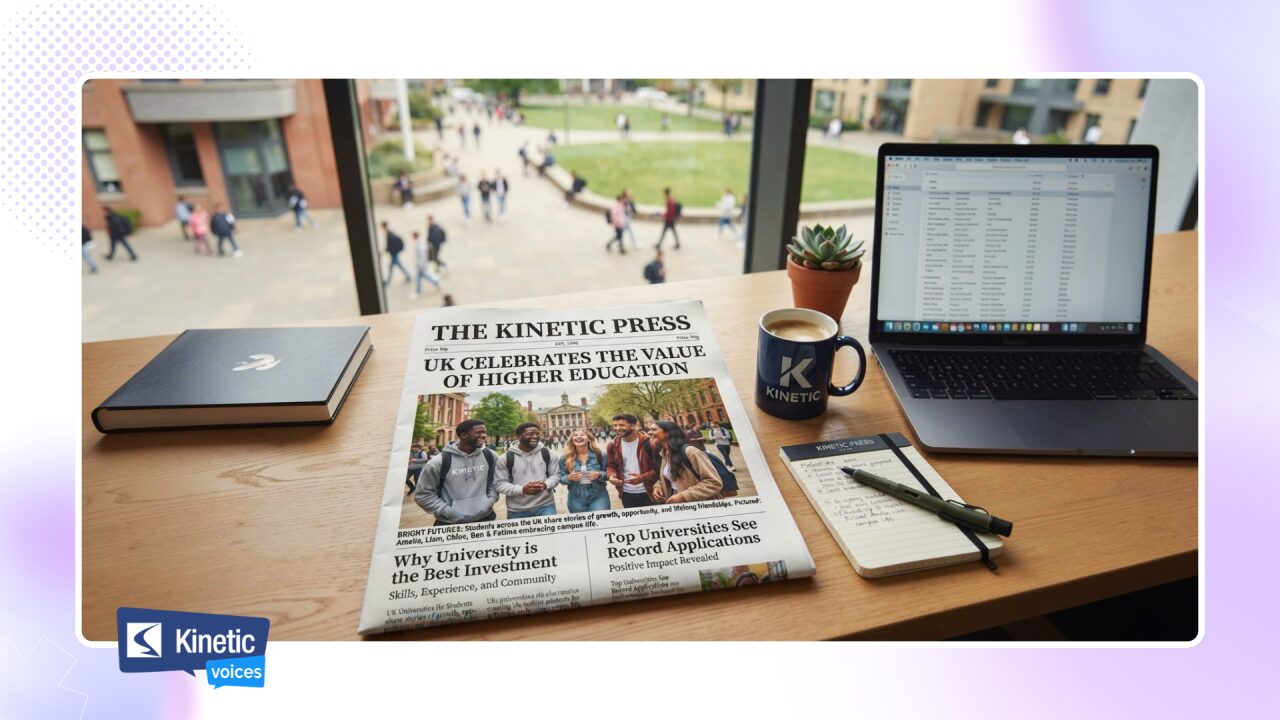
By Clare Ody, VP of PBSA, Brand & Partnerships at Kinetic on the Higher Education Sector
Dr Jo Saxton CBE said what more of us need to be saying: the positive, confident, data-backed case for higher education. That interview has inspired me to speak up.
I listened to Dr Jo Saxton’s interview on Times Radio last week, and I was properly on her side. She sat in that studio as the Chief Executive of UCAS and got hit with question after question designed to make higher education sound indefensible. ‘What’s the point in university?’ ‘Too expensive’. ‘Won’t get you a job’. ‘There’s no salary premium’. ‘Might as well not bother because AI is coming for your subject anyway’. And she didn’t flinch. She met every single one of them with evidence and with conviction, and it put a smile on my face.
I’ve spent the biggest part of my career around higher education and student living, and listening to her, I kept thinking: this is exactly what more of us need to be doing. Not reacting defensively when the sector gets another kicking in the press, but actually standing up and making the case, calmly and with the numbers to back it up. She did that, and I was inspired. Wouldn’t it be powerful if more of us did the same?
The press has decided higher education is a problem, but the applicants haven’t.
The thing that stuck with me most was her simply pointing at the numbers: Record numbers of UK eighteen-year-olds applied this year. Record numbers were expected to be accepted last week (A-level results day). Young people, given all the noise, all the cost-of-living pressure, all the AI panic, are still choosing to go to university. She used that as her anchor, and I think it was the right one. Whatever the loudest commentators think should be happening, hundreds of thousands of actual applicants are looking past the headlines and making their own judgement.
She also pushed back on the “too many people go to university” framing, and I was cheering her on for it. Only around a third of UK eighteen-year-olds currently take up a place. If anything, the conversation should be about the people not going at all, and how to support young people and school-leavers with life-long learning and employment – not about whether the ones who do go to uni are making a mistake.
The cost of university will always come up – but it’s not the whole story.
What I respected most was that she didn’t get defensive about cost. £50k or £60k of debt is a serious thing to take on at 18 years old, and parents are right to ask hard questions about it. Jo acknowledged that plainly, and then made her case anyway, with real numbers rather than platitudes.
The lifetime earnings data she quoted is real – and something I didn’t know before now. Earnings are roughly £100,000 more over a career for graduates! And the graduate jobs pipeline isn’t shrinking either, with Jo pointing out that government projections suggest we’ll need more graduates, not fewer, by 2035:
I think it’s always important to pursue something that you love. They say if you do something you love, then you never work a day in your life. Also, the government’s own planning suggests that by 2035, over 80% of jobs are likely to need to be graduate jobs. So the need for graduates is not diminishing.
And the point that struck me as really surprising was UCAS’s own research showing students actually overestimate what they’ll repay each month as a graduate. They assume it’ll cost them around £500 a month, when the real figure on an average graduate salary is closer to £50. That’s exactly the kind of myth-busting the sector needs to be doing more of, out loud, the way she did on air.
I think this conversation could go even further than the interview had time for.
Dr Jo Saxton made her case brilliantly within the time she had. But there’s a whole other layer of value I don’t think gets airtime in these segments or in the press, and it’s the bit I’d want to add to what she was saying.
Going to university is very often the first time a young person lives away from home (if they’re not a commuting student). They’re doing their own washing, managing their own money, working out how to resolve a disagreement with a flatmate without a parent stepping in. They’re meeting people from completely different backgrounds, different countries, different politics, different life experiences to their own, and having to actually engage with that rather than just observe it from a distance. They’re joining societies, going to the wrong lecture at the wrong time, staying up too late arguing about something that felt enormously important at the time. They’re failing at things, in a relatively safe environment, and figuring out how to pick themselves back up.
That’s not a side effect of a degree. For a lot of young people, that’s where they actually grow up. I know I did. I don’t think you can put a salary premium on learning to live independently, or on the friendships and worldview that come from 3-4 years surrounded by people who aren’t from your hometown, your school, or your background. That’s part of the value too, and it barely gets a mention when the headlines are all about tuition costs and graduate salaries.
What parents and young people need to hear.
I wish this were more of a balanced conversation rather than a one-sided one in either direction. Not “higher education is broken,” which is the story the press keeps running with, but not “university is the only path” either, because it isn’t, and apprenticeships and other routes deserve just as much respect.
But for the young people who do want to go to uni, and are weighing it up against genuinely scary or eye-watering headlines, I want them (and other decision makers in the family) to see the full picture: the lifetime earnings data and the myth-busting on loan repayments. That UK young people are still voting with their feet and applying for university in record numbers. And alongside that, the independence, the friendships, the exposure to different people, cultures and ideas, and the confidence that comes from managing on your own for the first time. As well as the incredible support they get from university services, accommodation teams, and PBSA staff, that add to the overall student experience.
Dr Jo Saxton stood up for this sector on live radio this week, calmly and with conviction. I felt genuinely proud and inspired listening to her do that. I just think there’s more of the story still to tell, and it got me thinking how we all can do more positive PR for the higher education sector we love, alongside her. Here’s my first contribution, and I don’t intend it to be my last either.
This piece is the personal reflections prompted by Dr Jo Saxton’s interview with Times Radio Breakfast, on 11 August 2026. Dr Saxton CBE has not been interviewed by Kinetic Software – she has simply been an inspiration, prompting us to speak up about the case she argued so confidently.
Read more Kinetic Voices here.